
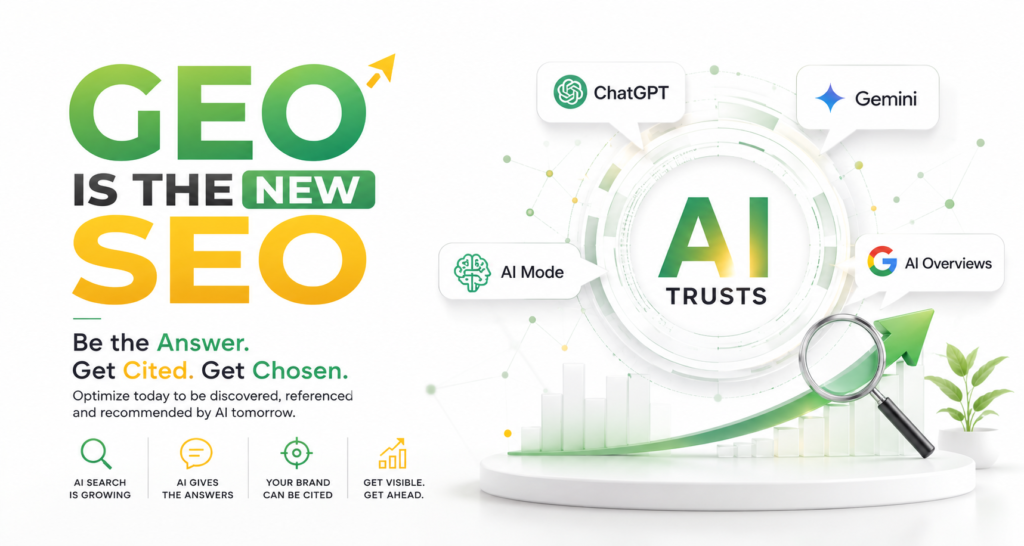
GEO Is the New SEO: How to Get Your Brand Cited by ChatGPT, Gemini & AI Overviews
Your next customer may not Google your business.
They may ask:What are the best digital marketing agencies for small businesses in Pune?Or:
Which agency should I hire for performance marketing and lead generation?
Or:
Who are the best digital marketing trainers in India?
And instead of receiving ten blue links, they may receive an AI-generated answer—with a handful of brands, websites and sources cited.
Is your brand one of them?
That is the opportunity behind GEO — Generative Engine Optimization.
But there is an important misconception to remove immediately:
GEO is not a replacement for SEO.
Google’s current guidance says the opposite: the same foundational SEO practices that help your website appear in traditional Search remain relevant to AI Overviews and AI Mode.
The difference is what happens after your content becomes discoverable.
Traditional SEO tries to win a search result.
GEO aims to make your brand a useful, trustworthy source that AI systems can understand, retrieve, summarize and cite.
And that changes how businesses should think about content.
What Is GEO?
GEO, or Generative Engine Optimization, is the practice of improving a brand’s online presence so that generative AI systems can accurately understand, reference and potentially cite the brand when answering relevant user questions.
Those systems can include:
- ChatGPT Search
- Google AI Overviews
- Google AI Mode
- Gemini-powered experiences
- Other AI-powered search and answer engines
The exact systems and retrieval mechanisms differ, so there is no universal “GEO ranking formula.”
In fact, Google explicitly cautions against claims that there are special hacks or requirements for appearing in its AI search features. Pages still need to meet normal Search eligibility and quality requirements.
So think about GEO less as a new technical trick and more as a new layer of search visibility.
Traditional SEO |
Targets search queries |
Optimizes pages for search engines |
Focuses heavily on rankings |
User visits search results |
Links are the destination |
Keywords are important |
GEO |
Targets questions and information needs |
Optimizes information for retrieval and synthesis |
Focuses on visibility within AI-generated answers |
AI may summarize the answer first |
Citations can become the discovery mechanism |
Entities, context, evidence and topical authority matter |
SEO vs GEO
The two strategies should therefore work together.
SEO gets your content discoverable. GEO helps make that content useful to AI-mediated discovery.
Why GEO Matters Now
Search behaviour is becoming increasingly conversational.
Google’s AI Mode can break a complex question into multiple subtopics and search for them simultaneously—a process Google describes as “query fan-out.”
Google is also continuing to expand AI Overviews and AI Mode. In 2026, Google described AI Mode as a deeper search experience designed for complex questions, follow-ups and exploration.
ChatGPT Search similarly provides answers using web sources and citations. OpenAI says websites can appear in ChatGPT Search and recommends ensuring that its search crawler, OAI-SearchBot, is not blocked if publishers want their content to be discoverable and potentially cited.
This creates a new competitive question:
When someone asks AI about your category, what does AI know about your brand?
Not:
Does my website have enough keywords?
But:
Is my brand represented clearly and consistently across the web?
How AI Search Decides What to Surface
There isn’t one universal GEO algorithm.
However, there are several practical signals marketers should pay attention to.
- Relevance
Your content needs to directly address the question.
If someone searches:
How much does digital marketing cost for a small business?
A vague homepage saying “We provide innovative digital solutions” isn’t particularly useful.
A detailed page explaining:
- typical service models
- factors affecting cost
- campaign budgets
- expected deliverables
- common pricing structures
- examples
- limitations
is much easier to interpret.
Specific questions require specific answers.
- Originality
This is becoming increasingly important.
Google’s 2026 guidance specifically emphasizes unique, valuable and non-commodity content for generative AI experiences.
If 500 websites publish essentially the same article—
“10 Benefits of Digital Marketing”
—there is little reason for an AI system to consider your version uniquely valuable.
Instead, add something competitors cannot easily copy:
- your methodology
- original examples
- first-hand observations
- customer questions
- proprietary frameworks
- experiments
- case studies
- data
- expert commentary
- local market knowledge
Your experience is an SEO asset.
- Clear Expertise and Entity Signals
AI systems need to understand who you are and what you are known for.
For example, don’t make your website say:
“We are a leading company providing innovative solutions.”
Make it clear:
“Krishi’s Digital is a digital marketing agency focused on performance marketing, lead generation, AI-powered marketing and digital growth.”
Then reinforce that positioning consistently through:
- About page
- service pages
- founder profile
- Google Business Profile
- interviews
- guest articles
- industry directories
- case studies
- social profiles
- third-party mentions
This creates a clearer entity footprint.
- Evidence Beats Empty Expertise Claims
Anyone can write:
“We are experts in SEO.”
Evidence is stronger.
For example:
Weak:
We deliver exceptional SEO results.
Stronger:
Our SEO process begins with technical auditing, search-intent mapping, content-gap analysis and internal-link architecture.
Even stronger:
We identified that a client’s traffic problem wasn’t primarily keyword rankings—it was weak topic coverage and poor conversion paths. We rebuilt the content architecture around commercial search intent.
The last version contains experience, methodology and reasoning.
Those are much more valuable than adjectives.
- Build Content Around Questions, Not Just Keywords
Traditional keyword research often starts with:
What keyword should we rank for?
GEO requires another question:
What questions does my ideal customer ask before buying?
For a digital marketing agency, that might include:
- Which digital marketing agency is best for startups?
- How much does performance marketing cost?
- Should a small business invest in SEO or Google Ads?
- How long does SEO take to generate leads?
- How can AI help with digital marketing?
- What is GEO?
- How do I get my business recommended by ChatGPT?
- Which marketing channels generate leads fastest?
Each question can become a content asset.
And importantly, don’t stop at the obvious question.
Build question clusters.
Example
Main topic: Performance Marketing
Supporting questions:
- What is performance marketing?
- How much should a business spend?
- Google Ads vs Meta Ads?
- What KPIs should businesses track?
- Why are leads expensive?
- How can AI improve campaign optimization?
- When should a business hire an agency?
This creates topical depth instead of isolated articles.
- Make Important Answers Easy to Extract
AI systems often need to identify useful information from a page.
Help them.
Use:
Clear headings
Instead of:
Some Things You Should Know
Use:
How Much Does SEO Cost in India?
Direct answers
Answer the question immediately, then explain it.
Lists
Lists make complex information easier to process.
Tables
Tables are particularly useful for comparisons.
Definitions
Clearly define important concepts.
Examples
Show how the concept works in practice.
This doesn’t mean writing for machines.
It means making information easier for humans and machines to understand.
- Strengthen Your Website’s Technical Foundation
GEO does not eliminate technical SEO.
Quite the opposite.
If your page cannot be properly crawled, indexed or understood, you have a fundamental visibility problem.
Google says pages need to meet normal Search technical requirements and be eligible for indexing to appear as supporting links in AI Overviews or AI Mode.
Review:
- robots.txt
- indexing
- XML sitemap
- canonical tags
- internal links
- page speed
- mobile usability
- structured data
- HTTPS
- duplicate content
- broken links
- crawlability
For ChatGPT Search specifically, OpenAI states that publishers should avoid blocking OAI-SearchBot if they want their content to be discoverable and potentially cited.
- Don’t Ignore Off-Website Authority
One of the biggest GEO mistakes is thinking:
I’ll publish more blogs on my website.
That is only part of the strategy.
AI systems can encounter your brand through many sources.
Consider building authority through:
- industry publications
- credible directories
- interviews
- podcasts
- YouTube
- partner websites
- customer reviews
- case studies
- expert contributions
- conference profiles
- local business listings
Why?
Because your website tells AI what you say about yourself.
Third-party sources can help establish what others say about you.
That distinction matters for credibility.
Common GEO Mistakes
Mistake 1: Treating GEO as a Keyword Trick
Adding “GEO” to every article won’t make your brand visible.
Fix: Build authority around the questions your customers actually ask.
Mistake 2: Publishing Generic AI Content
If your article could have been written by 100 competitors, it probably doesn’t create much differentiation.
Fix: Add original experience, evidence and perspective.
Mistake 3: Abandoning SEO
This is one of the biggest misconceptions.
Google explicitly states that foundational SEO remains relevant to its generative AI search experiences.
Fix: Think SEO + GEO, not SEO versus GEO.
Mistake 4: Chasing Every AI Platform
Trying to reverse-engineer every model is inefficient.
Fix: Build strong, accessible, trustworthy content that can be discovered across systems.
Mistake 5: Measuring Only Website Traffic
AI search can influence discovery before the user ever visits your website.
Track:
- brand mentions
- citations
- referral traffic
- branded searches
- qualified leads
- assisted conversions
- AI-search visibility
- source domains
Google has also begun rolling out dedicated Search Console reporting for visibility from generative AI features such as AI Overviews and AI Mode, although the reporting is being introduced progressively.
The Bigger Opportunity: Become the Source, Not Just the Search Result
The most important shift isn’t technical.
It is strategic.
For years, businesses competed to become:
The result people click.
AI search introduces another possibility:
The source AI uses to answer the question.
That changes content strategy.
Instead of asking:
What should we publish this week?
Ask:
What should our market know us for?
Then build the evidence.
Create the best explanation.
Answer the difficult questions.
Publish original insights.
Earn credible mentions.
Make your expertise easy to understand.
And keep your technical SEO foundation strong.
That is where GEO and SEO stop being two separate strategies and become one broader search-visibility system.
Frequently Asked Questions
Is GEO replacing SEO?
No. GEO should be viewed as an extension of modern search visibility. Google explicitly states that foundational SEO practices remain relevant to AI Overviews and AI Mode.
How do I get my website cited by ChatGPT?
There is no guaranteed citation formula. Start with crawlable, indexable, useful and authoritative content. OpenAI says websites can appear in ChatGPT Search and recommends allowing OAI-SearchBot to access content you want discovered.
Does Google have a special GEO ranking factor?
Google's official guidance does not describe a separate “GEO ranking factor.” Instead, Google says its existing SEO and quality systems underpin AI search experiences.
What is the difference between AEO and GEO?
AEO generally refers to optimizing content for answer engines and direct answers, while GEO is commonly used for optimization around generative AI systems. The terminology isn't completely standardized across the industry.
Can small businesses benefit from GEO?
Yes. Smaller businesses can compete by developing strong topical expertise, first-hand content, local relevance, reviews, case studies and credible third-party mentions.
Does structured data guarantee AI citations?
No. Structured data helps search engines understand content, but it does not guarantee rankings, AI Overviews or citations. Google continues to emphasize relevance, quality and eligibility rather than guaranteed AI visibility.
How often should I test my AI visibility?
Start monthly. Test the same commercially important questions consistently and record mentions, citations, competitors and sources. For rapidly changing industries, increase the frequency.