
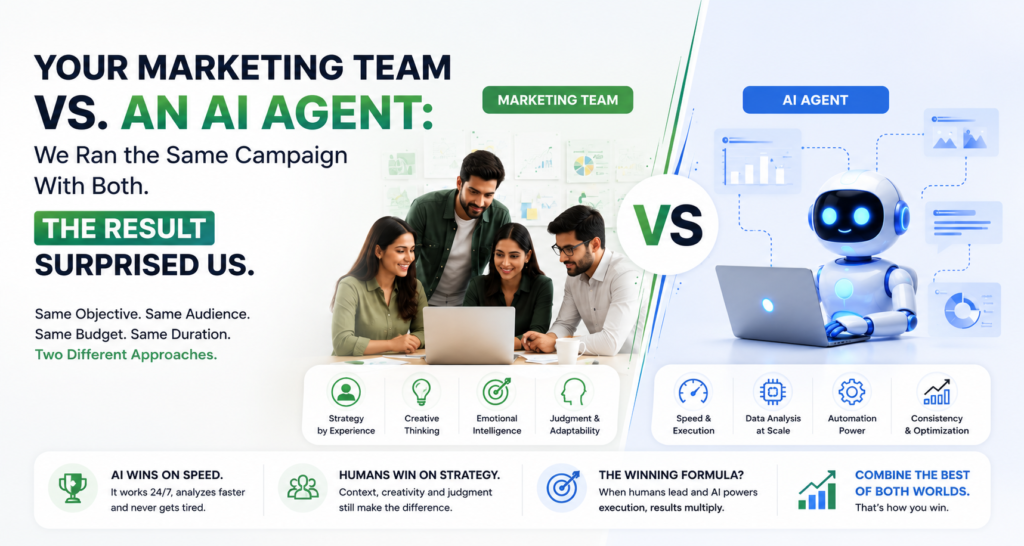
Your Marketing Team vs. an AI Agent: We Ran the Same Campaign With Both. The Result Surprised Us.
What happens when you give a human marketing team and an AI agent the exact same campaign brief? Same objective. Same audience. Same product. Same brand information. Same constraints.
At first, it sounds like a simple competition: human marketers versus AI. But that turned out to be the wrong question.
The more useful question is: which parts of marketing should humans own, and which parts should AI take over? The answer was surprisingly practical. AI was faster than expected. Humans were more valuable than expected. And the strongest model wasn’t either one—it was the combination.
The Experiment: Human Team vs. AI Agent
To make the comparison useful, both sides should start with the same campaign brief. The objective could be lead generation: generate qualified enquiries from decision-makers interested in a specific service.
Both workflows receive the same target audience, product information, brand positioning, campaign objective, customer pain points, available channels and call-to-action.
The human team works through its normal marketing process. The AI agent follows a structured workflow involving research, audience analysis, content generation, campaign variations and performance analysis.
This isn’t a scientific benchmark unless the same data, tools, time limits and evaluation criteria are controlled. The purpose is operational: identify which tasks should be automated and which should remain human-led.
Round 1: Understanding the Audience
The AI agent can process a campaign brief quickly and identify potential audience segments, pain points, objections, search questions, messaging angles and content themes.
It can generate a large number of possibilities in a very short time. But speed isn’t the same as understanding.
A human marketer can ask: “Would our customer actually say this?” Experience helps marketers recognize when a technically logical segment does not match real buying behavior.
The takeaway: AI wins on research speed. Humans win when context matters.
Round 2: Creating the Campaign Idea
The AI agent can generate multiple campaign concepts quickly. Some will be strong, some predictable, and some may sound like things every other company in the industry could publish.
That is one of the biggest risks of using AI for marketing: AI can produce content that is correct without being distinctive.
Human marketers are more likely to challenge the obvious idea. They can ask why someone would stop scrolling for this, whether it actually differentiates the brand, and whether a competitor could use the same campaign.
The takeaway: AI is excellent for idea expansion. Humans remain critical for idea selection and positioning.
Round 3: Copywriting
This is where an AI agent creates significant leverage. With a properly defined brief, it can generate headlines, ad copy, email variations, social captions, landing-page sections, CTAs and hooks rapidly.
Instead of starting from a blank page, the marketing team has options. The marketer can spend more time deciding which version is actually worth testing.
But AI-generated copy can still be generic, repetitive, overly polished, exaggerated or inconsistent with a brand’s natural voice. Human editing remains important.
The takeaway: AI is the production accelerator. Humans are the quality filter.
Round 4: Campaign Testing
Imagine having 20 headline variations. A human team can review them, while an AI agent can classify and organize them by pain point, audience segment, emotional angle, CTA, offer and funnel stage.
That makes experimentation faster. But more testing does not automatically mean better marketing.
If the wrong KPI is being optimized, AI can make the wrong decision faster. A campaign might generate more clicks while attracting lower-quality leads. The system therefore needs to understand the actual business objective—not simply “get more clicks,” but generate qualified enquiries with realistic commercial potential.
The takeaway: AI is powerful at pattern recognition and iteration. Humans must remain responsible for what success means.
Round 5: Optimization
Once campaign data starts arriving, an AI agent can help summarize performance and identify patterns. It can compare variations, highlight audience differences, suggest what to test next and organize campaign signals.
This is where automation becomes especially valuable. A marketer doesn’t need to manually inspect every repetitive data point.
But optimization is risky when the objective is too narrow. AI should recommend; humans should decide when the decision affects budget, brand reputation or customer experience
The takeaway: AI accelerates analysis. Humans protect the business objective.
The Result That Actually Surprised Us
The biggest surprise wasn’t that AI could do marketing work. We already know it can.
The surprise was this: the human team became more valuable when AI handled more of the repetitive work.
When AI handles research summaries, content variations, repetitive analysis, data classification, campaign reporting, first drafts and routine workflow actions, the human team gets more time for strategy, positioning, customer understanding, creative direction and commercial decisions.
AI didn’t eliminate the marketer. It changed what the marketer should spend time doing.
Where AI Agents Create the Most Value
A useful rule is to automate tasks that are frequent, structured, measurable and repeatable.
Strong candidates include lead management, content production, campaign reporting, research, marketing automation and follow-up drafting.
AI can classify enquiries, summarize conversations, turn one core idea into multiple content formats, organize research themes, summarize performance data and draft personalized follow-ups using approved context.
Where Humans Should Stay in Control
Not every marketing decision should become autonomous. Human oversight remains particularly important for brand positioning, sensitive customer communication, pricing decisions, legal or compliance claims, reputation-sensitive campaigns, major budget allocation, partnerships and crisis communication.
The more expensive the mistake, the stronger the case for human approval.
How Businesses Should Start
Don’t try to create a fully autonomous marketing department on day one. Start with one process, such as reporting, lead classification, content repurposing or follow-up.
Map the current workflow. Identify repetitive steps. Automate low-risk actions. Add AI where interpretation or personalization creates value. Keep human approval for important decisions.
Then measure time saved, response speed, output quality, error rate, lead quality, testing velocity and commercial outcomes.
The goal isn’t to produce more marketing. The goal is to produce better marketing decisions with less wasted effort.
The Biggest Mistake Companies Make With AI Marketing
Companies often ask, “What can AI do?” A better question is: “What should AI do?”
AI can generate thousands of ideas, but your business needs the right idea for the right audience at the right time. AI can write hundreds of posts, but your audience needs useful information that builds trust.
AI can analyze huge amounts of data, but someone still needs to decide which business outcome matters. That is why AI strategy should begin with the operating model—not the tool.
The Future Isn’t AI vs. Humans
The AI-versus-human debate is too simplistic. Marketing is a chain of decisions. Some are repetitive, some analytical, some creative, some emotional and some commercial.
AI can become extremely powerful across speed, repetition and structured analysis. Humans remain essential for many decisions involving context, empathy, positioning and accountability.
The competitive advantage will belong to businesses that combine the two effectively. The winning team may not have the most AI tools. It may have the best workflow between human judgment and machine execution.
Approximate article body word count: 1111 words
The Future Isn’t AI vs. Humans
The AI-versus-human debate is too simplistic. Marketing is a chain of decisions. Some are repetitive, some analytical, some creative, some emotional and some commercial.
AI can become extremely powerful across speed, repetition and structured analysis. Humans remain essential for many decisions involving context, empathy, positioning and accountability.
The competitive advantage will belong to businesses that combine the two effectively. The winning team may not have the most AI tools. It may have the best workflow between human judgment and machine execution.
Approximate article body word count: 1111 words
Frequently Asked Questions
Is AI better than a human marketing team?
Not universally. AI is particularly strong at speed, repetition, structured analysis and generating variations. Humans remain stronger at context, positioning, empathy, creativity and judgment.
Can AI agents run marketing campaigns?
AI agents can automate significant parts of campaign research, content production, analysis and workflow execution. Human oversight remains important for strategy, brand decisions and higher-risk actions.
What marketing tasks should businesses automate first?
Start with repetitive and measurable processes such as reporting, lead classification, content repurposing, research summaries, campaign variations and routine follow-up.
Will AI replace digital marketers?
AI is more likely to change the responsibilities of marketers than eliminate the need for marketing expertise. Teams that understand strategy, data, customers and AI workflows can use automation to increase their leverage.
How can AI improve campaign performance?
AI can accelerate research, generate more testable variations, identify patterns in campaign data and automate repetitive execution. Performance still depends on the quality of the strategy, data and decisions surrounding the AI.
Should AI-generated content be published without human review?
For important customer-facing content, human review is recommended. AI can produce errors, unsupported claims or messaging that doesn't fit the brand.
What is the best human-AI marketing workflow?
A practical model is human strategy → AI research → AI production → human approval → AI execution and analysis → human decision-making.